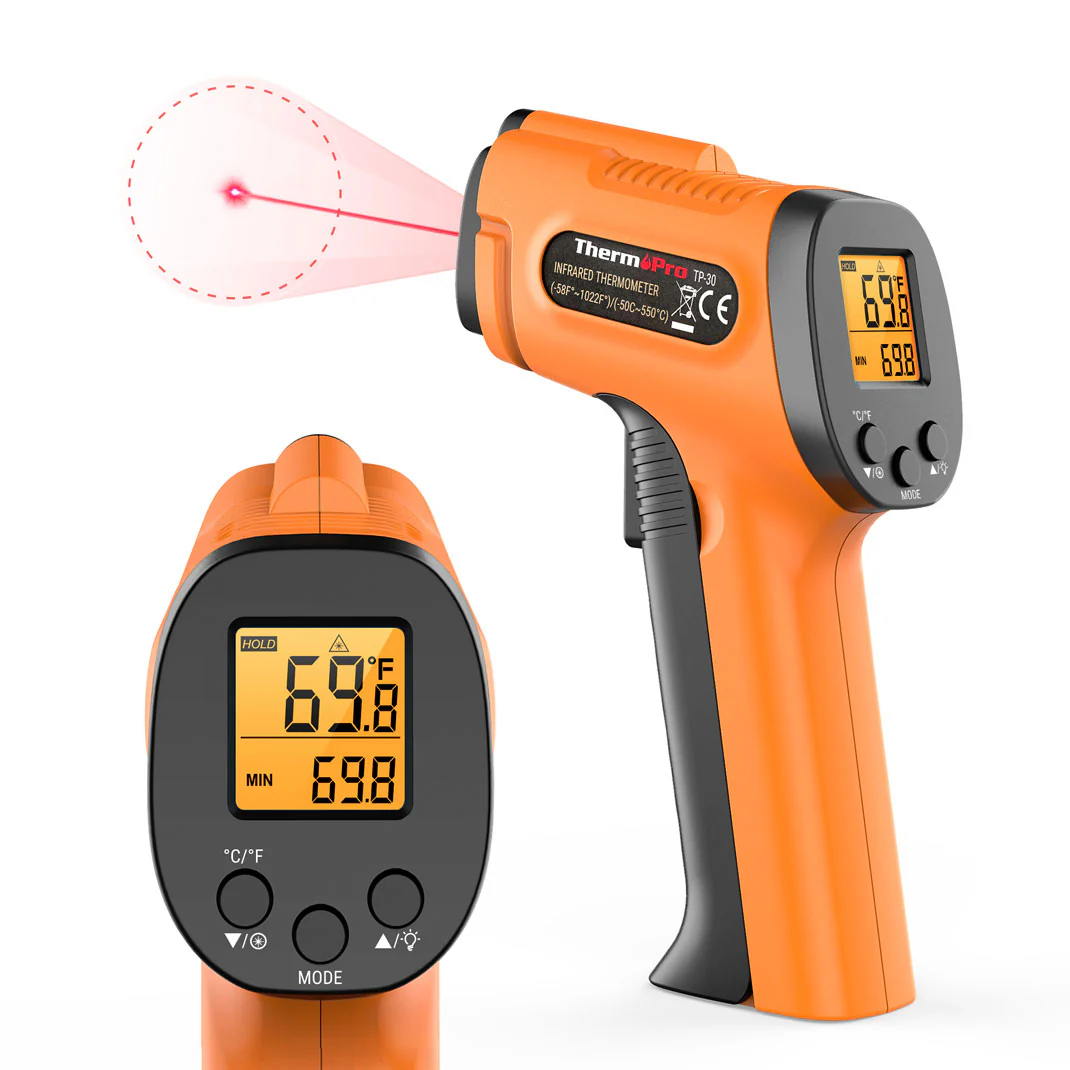
Whether you're a chef ensuring food safety in a Dubai hotel, a plant engineer maintaining machinery in an Ajman factory, or an HVAC technician diagnosing a cooling system — there's one instrument that can help you work faster, safer, and smarter: the infrared thermometer.
Yet millions of professionals across the UAE still rely on slower, riskier contact-based methods when a quick, non-contact reading would do the job better. This guide breaks down exactly what IR thermometers do, who needs them, how to choose one, and why ThermoPro UAE is the region's most trusted source for professional-grade temperature measurement tools.
1. What Is an Infrared Thermometer?
An infrared thermometer — also called a non-contact thermometer, laser thermometer, or IR gun — measures surface temperature from a distance without any physical contact with the object being measured. Instead of touching a probe to a surface, you simply point the device at the target and pull the trigger. The reading appears almost instantly.
Unlike traditional thermometers that measure the heat conducted into the instrument, IR thermometers detect the infrared radiation naturally emitted by all objects above absolute zero. The hotter an object, the more IR energy it emits — and the sensor inside the thermometer converts that energy into an accurate temperature reading.
💡 Infrared thermometers are the only practical way to measure the temperature of moving objects, extremely hot surfaces, inaccessible equipment, or any surface where contamination must be avoided — like food in a commercial kitchen.
2. How Does It Work?
Infrared Emission
Every object emits infrared energy proportional to its temperature. Even a cold object emits some IR radiation.
Lens Capture
The thermometer's lens focuses the IR energy from the target area onto a thermopile detector inside the sensor.
Signal Conversion
The detector converts the IR energy into an electrical signal that the device's processor calculates into a temperature value.
Display & Output
The temperature is displayed on the screen — often with laser targeting for precise aiming — within milliseconds.
Most professional models also include an emissivity adjustment, which corrects for the fact that different materials (shiny metal vs. matte plastic vs. food) emit IR energy at different rates. Getting emissivity right is key to accuracy, especially in industrial settings.
3. Who Needs One? Key Use Cases in the UAE
From Michelin-starred kitchens in Downtown Dubai to petrochemical plants in Ruwais, IR thermometers are in daily professional use across every sector. Here are the most common applications:
Food Service & Hospitality
Check surface temperatures of grills, buffet lines, and cold storage without cross-contamination. Essential for HACCP compliance in UAE food establishments.
Industrial & Manufacturing
Monitor motor bearings, electrical panels, pipelines, and furnace walls from a safe distance. Ideal for predictive maintenance programs.
HVAC & Refrigeration
Diagnose AC duct losses, check refrigerant lines, and verify fridge and freezer performance in commercial spaces.
Electrical Maintenance
Detect hot spots in switchboards and circuit breakers before they become dangerous failures — without shutting down the system.
Construction & MEP
Measure surface temperatures during insulation testing, waterproofing verification, and concrete curing monitoring on UAE construction sites.
Home Cooking & BBQ
Check your frying oil temperature, griddle surface, and oven walls instantly. Pairs great with our oven thermometers.
4. IR Thermometer vs. Probe Thermometer: Which Is Better?
Both tools have their strengths. The best professionals use both — and ThermoPro even offers two-in-one IR & Probe thermometers that give you the best of both worlds.
| Feature | Infrared Thermometer | Probe Thermometer |
|---|---|---|
| Contact Required | ✗ No contact | ✓ Direct contact |
| Speed | ✓ Instant (~0.1 sec) | Slower (2–10 sec) |
| Measures Internal Temp | ✗ Surface only | ✓ Core temperature |
| Food Safety (HACCP) | Good for surfaces & liquids | ✓ Best for meat core temps |
| Hot / Hazardous Surfaces | ✓ Ideal — no risk | ✗ Dangerous |
| Moving Objects | ✓ Works perfectly | ✗ Not possible |
| Cross-Contamination Risk | ✓ Zero risk | Requires sanitizing — use probe wipes |
Two-in-One IR & Probe Thermometer
Get the best of both worlds — instant surface scanning with non-contact IR, plus accurate core temperature readings with a foldaway probe. Perfect for HACCP-compliant food service operations across the UAE.
View IR + Probe Models → All IR Thermometers5. How to Choose the Right IR Thermometer
Not all infrared thermometers are created equal. Here are the key specs to evaluate before purchasing:
Temperature Range
For kitchen use, a range of −50°C to +380°C is typically sufficient. For industrial applications — think furnaces, boilers, or electrical panels — you may need a range up to +1,000°C or beyond. Always match the thermometer's range to your highest expected surface temperature, with some headroom.
Distance-to-Spot Ratio (D:S)
This is arguably the most important spec. A 12:1 D:S ratio means at 12 cm from the target, the device measures a 1 cm diameter circle. A higher ratio means you can measure smaller, more precise areas from farther away. Industrial applications typically require 20:1 or higher; kitchen use is fine at 8:1 to 12:1.
Emissivity Settings
Fixed emissivity (typically 0.95) works for most food, rubber, and matte surfaces. If you're measuring shiny metals, plastics, or liquids, look for an adjustable emissivity model to ensure accuracy.
Response Time
Consumer models respond in 0.5 seconds; professional-grade industrial models can respond in under 100ms. For fast-moving conveyor lines or quick scanning workflows, response time matters.
Data Logging & Connectivity
Modern premium IR thermometers connect to apps or export data to spreadsheets — invaluable for quality control, audits, and compliance documentation. For serious industrial users, consider pairing an IR thermometer with a data logger.
6. ThermoPro's Top IR Thermometer Solutions in the UAE
ThermoPro UAE is one of the region's most comprehensive suppliers of professional measurement instruments, serving both the hospitality and industrial sectors with world-class brands and expert local support.
Whether you need a simple handheld IR thermometer for a café in Jumeirah or a complete temperature management system for a pharmaceutical warehouse in Jebel Ali Free Zone, ThermoPro's dual divisions cover it all. Their team offers local support, fast delivery across the UAE and GCC, and the expertise to help you choose exactly the right tool for your compliance requirements.
Thermal Camera — See the Full Picture
When a single-point IR thermometer isn't enough, a thermal imaging camera lets you scan entire surfaces at once. Ideal for building inspections, electrical audits, and preventive maintenance programs.
Explore Thermal Cameras →7. 5 Pro Tips for Accurate Infrared Readings
Know Your D:S Ratio
If your thermometer has a 12:1 ratio and you're standing 60 cm away, you're reading a 5 cm circle. Get closer for smaller targets, or invest in a higher-ratio model.
Avoid Reflective Surfaces
Shiny stainless steel, polished aluminum, and glass can reflect ambient IR radiation and give false readings. Adjust emissivity settings or place matte masking tape on the surface and measure that instead.
Account for Steam and Dust
Steam, smoke, dust, and fog between the thermometer and the target will absorb IR energy and reduce accuracy. Keep the path clear and the lens clean.
Let the Thermometer Acclimatize
If you bring your device from a cold, air-conditioned space to a hot kitchen or outdoor site, give it 5–10 minutes to adjust to the ambient temperature before taking critical readings.
Use IR for Scanning, Probe for Verification
In food safety workflows, use your IR thermometer to rapidly scan for temperature anomalies across many items, then use your probe thermometer to verify any concerning reading. Fast + accurate.
8. Frequently Asked Questions
Can an infrared thermometer measure food internal temperature?
Are infrared thermometers accurate in UAE outdoor conditions?
What is the difference between an IR thermometer and a thermal camera?
Do I need calibration certificates for industrial use in the UAE?
What is emissivity and do I need to adjust it?
Where can I buy professional infrared thermometers in Dubai?
Ready to Upgrade Your Temperature Measurement?
Explore ThermoPro UAE's full range of infrared thermometers, thermal cameras, and measurement instruments — trusted by professionals across hospitality, industrial, and construction sectors throughout the UAE and GCC.
Shop IR Thermometers Industrial Solutions